Hammam rituals · PROFESSIONAL GUIDE
Blue Nila Powder: Origin, Quality and a Professional Buying Guide
Composition, market variations, hammam uses and the documents to request: key points for selecting a blue Nila powder.
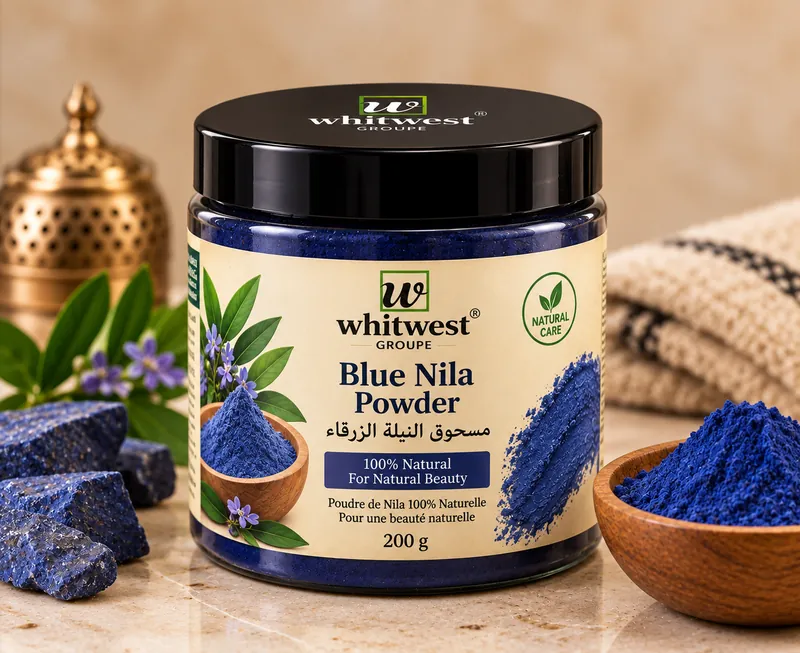
With its deep blue colour, Nila has become one of the most recognisable ingredients of Moroccan hammam rituals. It appears in pure powders, black soaps, scrubs and masks. For a brand or a spa, that popularity raises a simple question: what does the product sold under this name actually contain? This guide sets out the reference points for comparing offers and building a coherent range.
What is blue Nila?
The word nila evokes the colour blue and indigo. In Moroccan tradition, Nila is associated with indigo-bearing plants and their blue pigment, long used in crafts and in certain beauty rituals. It usually comes as a powder or paste, mixed with water, black soap or another base at the time of use.
The term is not a regulated name. The trade name alone is therefore not enough to know what material is in the jar.
Very different products under one name
On the market, Nila can refer to a powder of indigo plant leaves, a blend of botanicals, or a powder whose colour comes partly or entirely from mineral pigments such as ultramarine blues. These products are not prohibited as such, but they do not make the same promise. A buyer who communicates a plant origin must be able to substantiate it.
Colour intensity alone proves nothing. The ingredient list is the first document to examine: an INCI name such as Indigofera Tinctoria Leaf Powder does not mean the same thing as a colourant identified by a CI number, such as CI 77007. Ask for the full composition, including any carriers or fillers.
| Point to check | Question to ask |
|---|---|
| Composition | What is the product’s full INCI list? |
| Source of colour | Does it come only from the plant, or from added pigments? |
| Format | Pure powder, paste, or a ready-to-use formulated product? |
| Controls | What checks are carried out on each batch? |
| Packaging | Does the container protect against moisture and light? |
Uses in the hammam and in skincare
Nila traditionally features in the hammam ritual alongside black soap, exfoliation with a kessa glove and clay masks. Brands now offer it in scented black soaps, foaming creams, body scrubs and face masks. For a coherent range, define each product’s role in the ritual rather than adding Nila everywhere.
Plan for practical constraints: an intense blue pigment can temporarily mark towels, grout or some surfaces. For a spa, a trial under real conditions helps fine-tune usage and cleaning instructions.
Claims: stay precise
Nila is often associated with promises of radiance or an even-looking complexion. Every cosmetic claim must be substantiated. In the European Union, Regulation (EU) No 655/2013 sets common criteria, including honesty and supporting evidence. Avoid wording that suggests a medical effect or skin whitening, and have your texts validated by the responsible person for the target market.
Communication focused on the ritual, the texture, the colour and the verified origin of the ingredients is often more robust than an efficacy promise that is hard to demonstrate.
Quality, controls and storage
Like other plant-derived powders, Nila can carry a microbiological load that should be controlled. Ask which checks are performed on each batch and which results appear on the certificate of analysis. Also check the fineness of the powder if it is intended for the face, and the absence of foreign matter.
The powder should be kept in a closed container, away from moisture, heat and light. Once mixed with water, the preparation should be used promptly, unless it is a product formulated and preserved for that purpose. Our guide on reading a specification and certificate of analysis offers a method that also applies to powders.
Building an offer around Nila
For a launch, a pure powder with clear instructions lets you test your customers’ interest. A fuller range can combine a cleanser, a scrub and a mask, with consistent fragrance and presentation. Whitwest Groupe offers, among others, a blue Nila powder and a blue Nila body scrub; compositions and documents are confirmed for each project. Our guide to ghassoul clay complements this approach to the ritual.
Your buying checklist
- Full INCI list and source of the colour.
- A format suited to your use: powder, paste or formulated product.
- Batch certificate of analysis, including microbiological checks.
- Powder fineness for facial use.
- Packaging protected from moisture and light.
- Claims verified for the target market.
- A usage trial in the treatment room or at home.
Frequently asked questions about blue Nila
Is blue Nila always plant-based?
No. The trade name covers products of different compositions. Only the ingredient list and the supplier’s documents tell you where the colour comes from.
Can Nila be combined with black soap?
It is a common pairing in hammam rituals, either mixed at the time of use or as a ready-to-use product. The choice depends on your customers and how simple you want the routine to be.
Which documents should we request before ordering?
The full composition, a specification, the batch certificate of analysis and the safety data sheet where applicable. For the European market, also plan for the information the responsible person will need.
GO FURTHER
From guide to project.
Browse the related products and the information you need to prepare your request to our team.
Moroccan Blue Nila Powder